How to use the AI & Search Visibility (AI Mentions Tracker?
Track how AI platforms discover, mention, and recommend your brand across ChatGPT, Claude, Gemini, Perplexity & Google Search.
Written By Tom van den Heuvel
Last updated About 2 months ago
What is AI & Search Visibility?
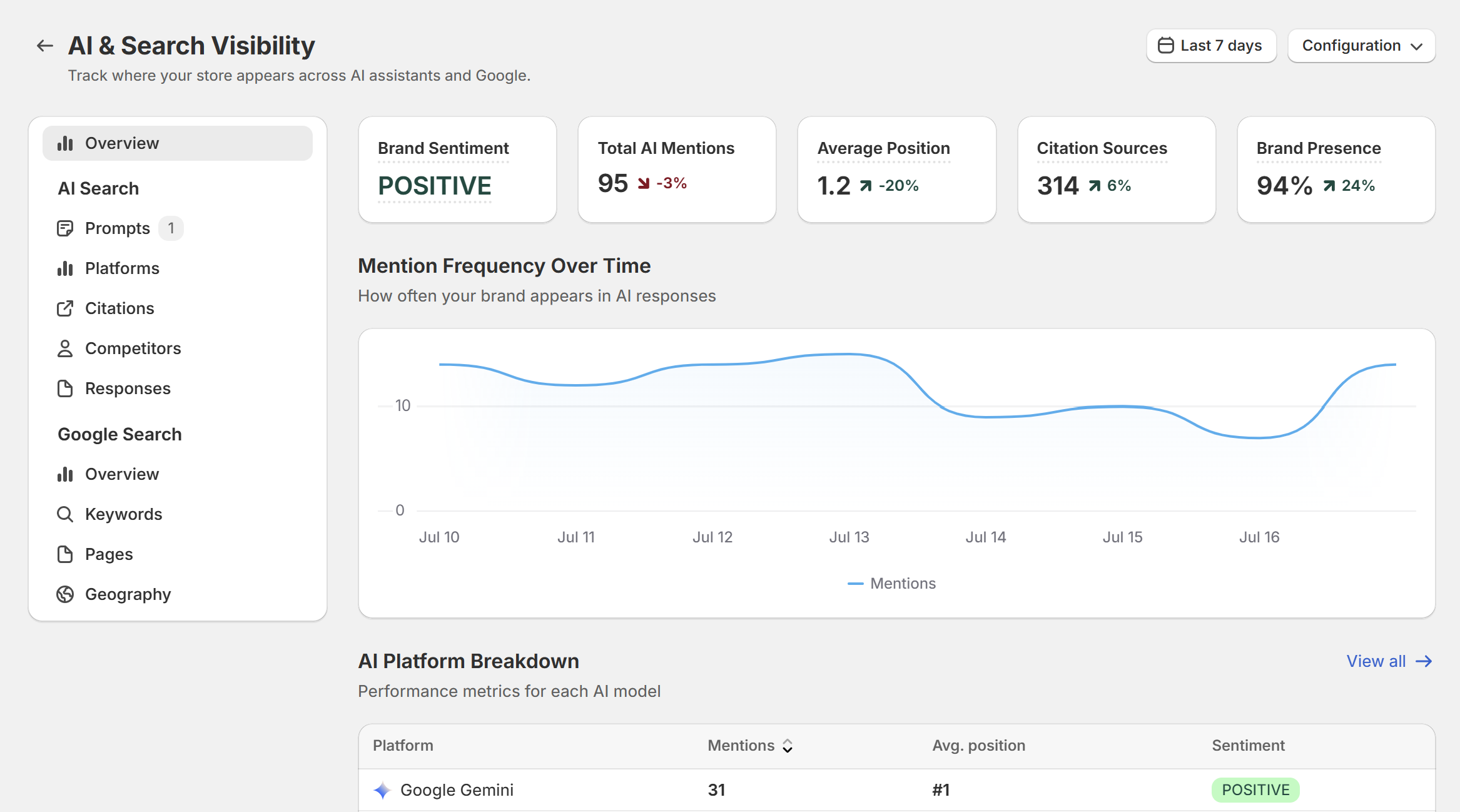
AI & Search Visibility shows where your store gets found across AI assistants and Google, in one place. It monitors when AI platforms like ChatGPT, Claude, Perplexity, and Gemini mention your brand in response to customer queries, and (once you connect Google Search Console) how you rank on Google alongside those AI mentions. Think of it as rank tracking for the whole discovery picture, AI and search together.
This was previously called the AI Mentions Tracker. It's now a full workspace with a sidebar: an AI Search section (mentions, tracked queries, citations, competitors, responses) and a Google Search section (keywords, pages, geography), with a combined Overview on top.
Why AI and search visibility matter
When potential customers ask an AI assistant "where should I buy [product type]?" or search Google for "best [category] stores," you want your brand to show up. Discovery drives direct traffic to your store, brand awareness and credibility, sales from AI-assisted and search-led shopping, and a competitive edge over brands that don't appear.
Example: a customer asks ChatGPT "best vitamin stores online" and your store appears in the top 3. That customer is highly likely to visit. The same is true when you rank on page one of Google for the queries your buyers use.
Step 1: Add tracking queries
Add questions customers might ask AI platforms about your product category:
Good query examples: "best [your category] stores," "where to buy [your product type] online," "top [your niche] brands," "most affordable [category] with good reviews," "best place to buy [product] in [region]."
Tips for effective queries:
✅ Use natural language (how people actually talk)
✅ Include your category or niche
✅ Think about customer pain points
✅ Add location-specific queries if relevant
✅ Include both brand and product queries
Step 2: We check the AI platforms
After you add a query, StoreRank sends it to ChatGPT, Claude, Gemini, and Perplexity, analyzes the responses for brand mentions, identifies which competitors are mentioned, extracts citation sources (articles, Reddit, reviews), and tracks sentiment (positive/neutral/negative). Processing takes about 2-5 minutes per query.
Step 3: Review your results
You'll see your mention count (how often you appear for this query), your ranking versus competitors, competitor mentions, citation sources, sentiment, and a per-platform breakdown.
Understanding your results
Mention count and ranking
Mentioned frequently means AI platforms recognize your brand as relevant. Not mentioned means you need to improve your AI visibility. Ranking position shows your competitive standing.
Example result:
Query: "best supplement stores online" · Your mentions: 2/4 platforms · Ranking: #3 (behind CompetitorA, CompetitorB) · Sentiment: Positive
What to do: if mentioned, maintain and improve your ranking. If not mentioned, focus on getting into citation sources (below). If ranked low, analyze what competitors are doing better.
Citation sources (your most valuable data)
Citation sources are the websites, articles, Reddit threads, and reviews AI platforms reference when making recommendations, for example Reddit threads on best stores, blog comparisons, review sites, industry lists, and social discussions.
Why they matter: AI platforms don't invent recommendations, they cite existing content. If you're mentioned positively in these sources, AI will recommend you.
Click "View sources" on any query to see the exact articles, threads, and sites AI referenced. In the Where AI Cites view, you can see this split by domain (which sources AI trusts) and by page (which specific URLs get cited).
Taking action based on results
Strategy 1: Get into missing sources. Identify where competitors appear that you don't. On Reddit, find relevant subreddits, give genuinely helpful answers, mention your store naturally when relevant, and build trust over time. For blogs and articles, reach out to authors, offer expert quotes or samples, and create content worth citing. For review sites, encourage satisfied customers to leave reviews and respond to all of them professionally.
Strategy 2: Improve existing mentions. If you're mentioned but ranking low, work out why competitors rank higher (more positive reviews, more sources, stronger recognition), get more mentions in the same sources, improve sentiment, and make sure your AI-optimized pages, FAQs, and schema are in place.
Strategy 3: Monitor sentiment. Keep amplifying positive sentiment, differentiate and build authority where it's neutral, and address the root cause immediately where it's negative.
The Google Search section
Connect Google Search Console to bring your Google performance in next to your AI mentions, so you can see the full discovery picture in one place.
How to connect
Open the Keywords, Pages, or Geography view (or the Google section of the Overview) and click Connect Google Search Console. Sign in with the Google account that owns your Search Console property and approve access. It takes about a minute. Your data starts appearing shortly after.
Connecting is optional, but it's what makes the combined view work. Google Search Console is the only source for your keyword-level rankings, so these views stay empty until you connect.
What you'll see once connected
Overview: your Google clicks, impressions, CTR, and average position alongside your AI metrics
Keywords: every keyword you rank for, with clicks, impressions, CTR, and position
Pages: which pages earn your Google clicks and where they rank
Geography: where your Google traffic comes from by country
Using AI and Google together
The real value is reading both sides at once. Two patterns to look for:
Ranking on Google but not mentioned by AI. These pages already have search authority, so they're strong candidates to turn into AI-cited content.
Mentioned by AI but weak on Google. Where AI already recommends you, there's often room to capture the Google search demand too.
Best practices
✅ Optimize product pages with high-quality content and FAQs
✅ Ensure your schema and llms.txt are active so AI crawlers can read them
✅ Engage in AI-cited sources like Reddit and industry blogs
✅ Use competitor queries to find where they're mentioned
✅ Connect Google Search Console so you can see AI and search side by side
Summary
AI & Search Visibility helps you see when and where your store is found across AI and Google, understand why certain stores get recommended and rank more often, and take direct action, by getting into cited sources and closing the gaps between where you rank and where you're recommended.