How to use Competitor Analysis?

Monitor how your brand performs against competitors in AI responses and identify opportunities for improved positioning.

Written By Tom van den Heuvel

Last updated 6 months ago

Understanding Competitor Analysis

The competitor analysis feature tracks how often competitors appear alongside your brand in AI responses, helping you understand market positioning and identify optimization opportunities.

What Competitor Analysis Reveals

Market Share of Mentions: How often each competitor appears in relevant AI responses
Position Rankings: Average ranking position for each competitor
Mention Context: How competitors are positioned relative to your brand
Trending Changes: Which competitors are gaining or losing visibility

Competitor Comparison Dashboard

Main Metrics Table

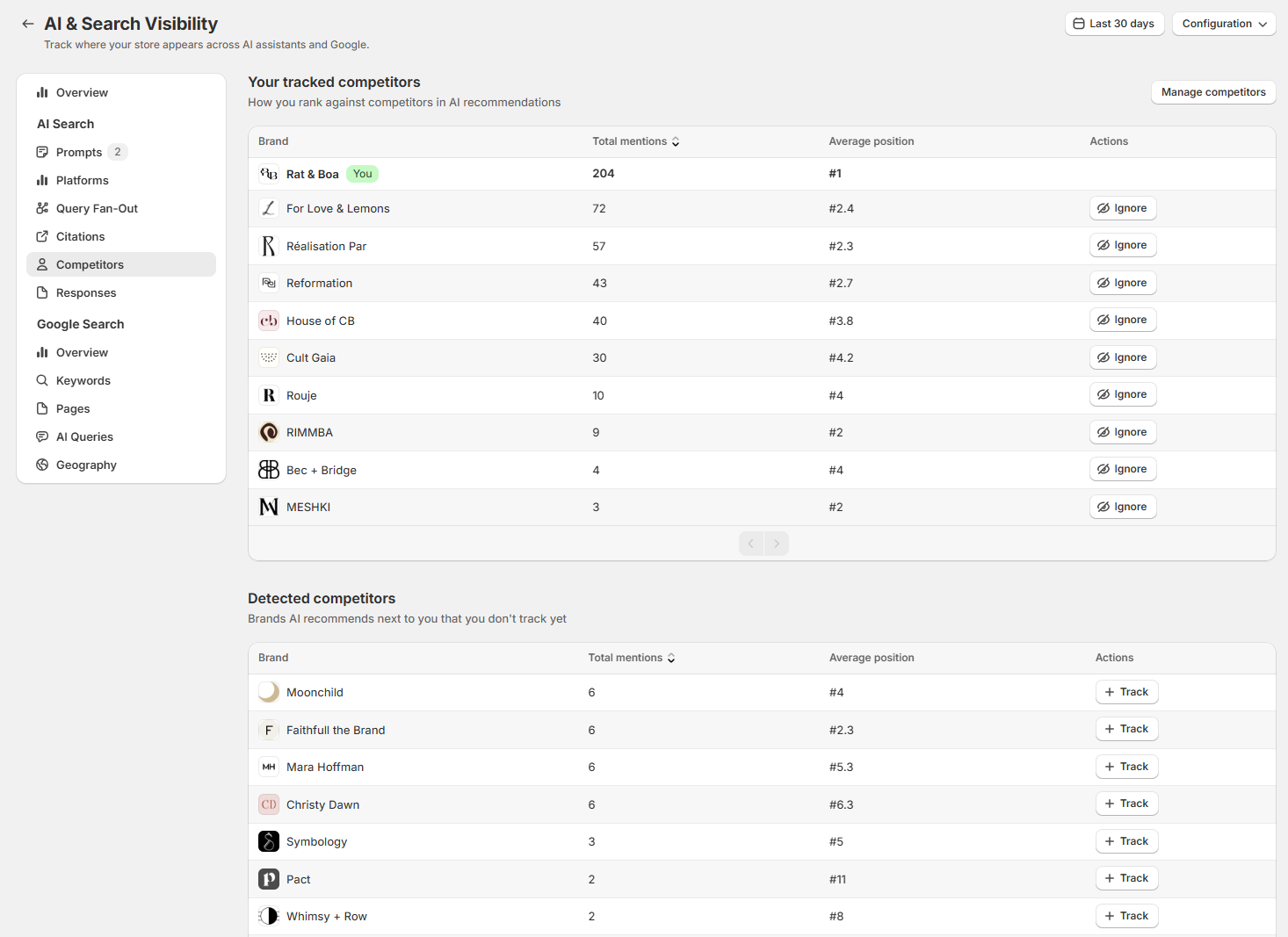
The competitor comparison shows:

Brand Name: Your brand highlighted as "You" plus competitor names
Total Mentions: Absolute number of mentions across all tracked queries
Average Position: Mean ranking position (lower numbers = better visibility)
Mention Trend: Increase or decrease compared to previous period

Interpreting the Data

High Mentions + Low Position: Strong competitor presence, frequent recommendations
Low Mentions + Low Position: Niche competitor with high relevance when mentioned
High Mentions + High Position: Widely mentioned but not top recommended
Low Mentions + High Position: Limited visibility, optimization opportunity

Competitive Intelligence Insights

Market Leaders Identification

Dominant Competitors:

  • Consistently rank in positions #1-3

  • High mention frequency across multiple queries

  • Positive sentiment in majority of mentions

  • Referenced by authoritative sources

Rising Competitors:

  • Improving position trends over time

  • Increasing mention frequency

  • Growing positive sentiment

  • New or innovative positioning

Declining Competitors:

  • Worsening position trends

  • Decreasing mention frequency

  • Negative sentiment increases

  • Outdated or problematic positioning

Opportunity Identification

Content Gap Analysis

Underserved Queries:

  • Queries where no competitor dominates

  • Long-tail opportunities with low competition

  • Emerging trends not yet addressed

  • Seasonal or niche market segments

Positioning Opportunities:

  • Benefits your competitors don't emphasize

  • Target audiences they don't address

  • Use cases they don't cover

  • Value propositions they don't claim

Competitive Advantage Development

Differentiation Strategies:

  1. Identify unique benefits competitors don't mention

  2. Focus on underserved customer segments

  3. Emphasize superior quality or value

  4. Highlight exclusive features or services

Content Optimization Focus:

  1. Create content addressing competitor weaknesses

  2. Develop detailed comparisons showing advantages

  3. Build authority in areas competitors lack

  4. Optimize for queries where competitors rank poorly

Regular Analysis Schedule

Weekly Monitoring:

  • Check position changes and trends

  • Identify new competitors appearing

  • Monitor significant ranking movements

  • Note changes in mention frequency

Monthly Deep Analysis:

  • Analyze competitor positioning strategies

  • Identify new content or optimization opportunities

  • Assess effectiveness of your improvements

  • Plan competitive response strategies

Quarterly Strategic Review:

  • Evaluate overall competitive landscape changes

  • Assess market share and positioning evolution

  • Plan major competitive initiatives

  • Adjust long-term optimization strategy

Competitive Response Strategies

When You're Behind Competitors

Position Improvement Tactics:

  1. Optimize content for queries where competitors rank well

  2. Create more comprehensive, authoritative content

  3. Build better schema markup and structured data

  4. Develop unique value propositions competitors lack

Content Strategy:

  1. Address gaps in competitor content

  2. Provide more detailed product information

  3. Include customer testimonials and reviews

  4. Highlight certifications and trust signals

When You're Leading

Maintaining Position:

  1. Continuously update and improve content

  2. Monitor for new competitors entering market

  3. Expand coverage to related queries and topics

  4. Strengthen unique differentiators

Market Expansion:

  1. Target new customer segments

  2. Enter related product categories

  3. Develop thought leadership content

  4. Build partnerships and endorsements

Competitive Analysis Best Practices

Data Interpretation Guidelines

Consider Context:

  • Total market size and growth

  • Seasonal or cyclical patterns

  • Industry changes and trends

  • AI platform algorithm updates

Focus on Trends:

  • Direction of change matters more than absolute numbers

  • Consistent improvements over time are valuable

  • Sudden changes may indicate specific events

  • Long-term patterns reveal strategic effectiveness

Actionable Insights Development

Convert Analysis to Action:

  1. Identify specific content improvements needed

  2. Develop targeted optimization priorities

  3. Create competitive content strategies

  4. Set measurable improvement goals

Avoid Common Pitfalls:

  • Don't copy competitor strategies directly

  • Focus on your unique strengths and advantages

  • Consider your specific target audience

  • Maintain brand voice and positioning consistency

Advanced Competitive Intelligence

Citation Source Analysis

Competitor Source Strength:

  • Which websites cite competitors most often

  • Quality and authority of competitor sources

  • Recent vs. outdated information patterns

  • Review site performance and ratings

Source Improvement Opportunities:

  • Build relationships with sites that cite competitors

  • Improve presence on review and comparison sites

  • Create citation-worthy content and resources

  • Develop partnerships with industry publications